
Why Does Kalamazoo Go to Bed So Early Now? |
Unveiling the nightlife mystery: What's causing Kalamazoo's early bedtime trend? Join us as we investigate! |
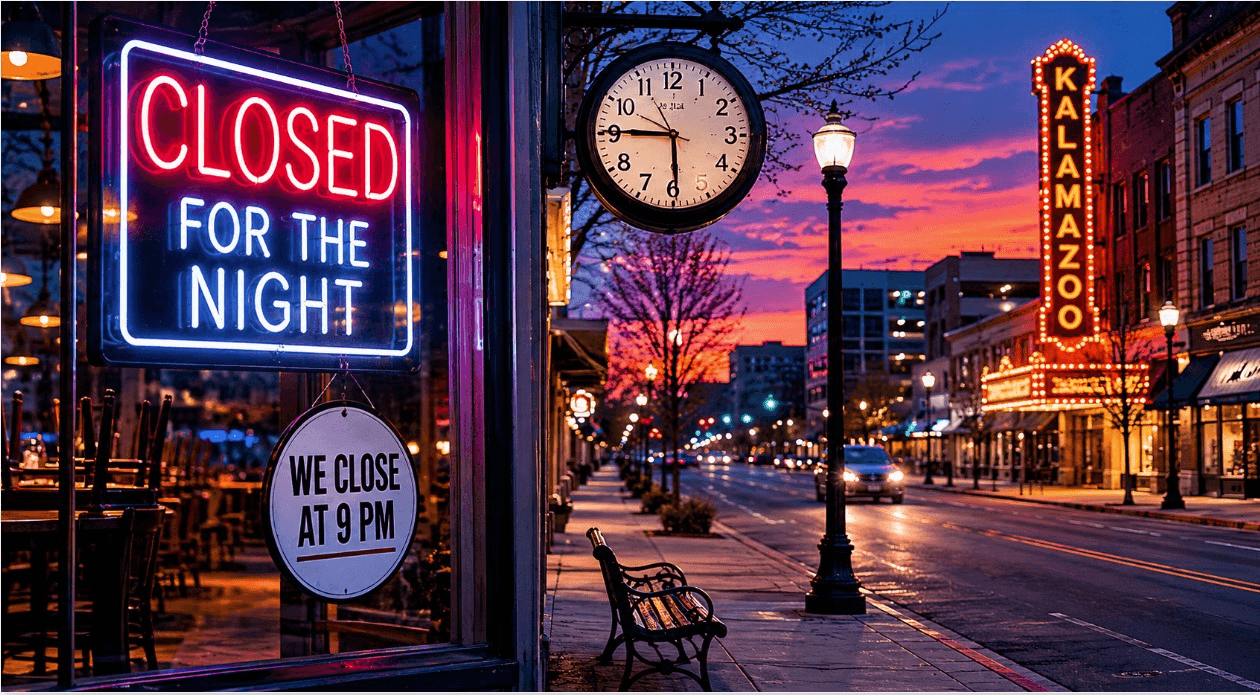
Not that long ago, it felt normal to run errands late at night.
Need groceries at 1:00 AM? No problem. Pharmacy run after dinner? Easy. Coffee after a late shift? Plenty of options. Even in Southwest Michigan, there were always places open late enough to make the community feel… alive.
Now? Many nights, Kalamazoo and Portage feel noticeably quieter after 9 or 10 PM.
And once you notice it, you can’t unsee it.
The shift happened slowly enough that most people never really talked about it, but the “24-hour culture” that used to define modern convenience has largely disappeared. Grocery stores that once stayed open all night now close earlier. Restaurants shortened hours and never fully brought them back. Some pharmacies reduced evening operations. Even major retailers that once operated around the clock quietly scaled back.
Part of this started during the pandemic, when businesses reduced hours because of staffing shortages and changing demand. But something interesting happened afterward: many companies realized they could continue operating with shorter schedules while lowering labor and operating costs.
And customers adapted.
That’s the part that may have changed local culture more than people realize.
We’ve quietly shifted from a “city that stays active late” to one that increasingly revolves around daytime and early evening activity. Coffee shops are packed in the morning. Lunch spots stay busy. Farmers markets and weekend events draw crowds. But late-night culture feels smaller than it once did.
For younger adults especially, this becomes a frequent frustration. Many people working nontraditional schedules—or simply wanting somewhere to go after 10 PM—often find their options surprisingly limited compared to even a few years ago.
But there may be a bigger reason behind the shift.
Communities like Kalamazoo and Portage are also changing demographically. Remote work, hybrid schedules, and an aging population have all subtly altered how people move through daily life. Fewer commuters working downtown until late. More people eating at home. More streaming and delivery culture. More emphasis on convenience and staying in.
Ironically, at the same time local communities are investing heavily in festivals, social districts, outdoor events, and gathering spaces, everyday late-night life has become quieter.
That doesn’t necessarily mean the area is declining. In many ways, Kalamazoo and Portage are more active socially than they’ve been in years. But the activity has shifted toward curated events and daytime experiences instead of spontaneous late-night movement. Maybe that’s simply the new normal.
Or maybe communities will eventually rediscover the value of places that stay open later—not just for convenience, but because they create energy, spontaneity, and the feeling that a city is still awake.
Either way, many longtime residents still remember when grabbing groceries at midnight didn’t feel unusual at all. |
0 Comments
Join the conversation
Be the first to comment
Share your thoughts above.