
Why Is THAT There? |
You've driven past it a hundred times.... |
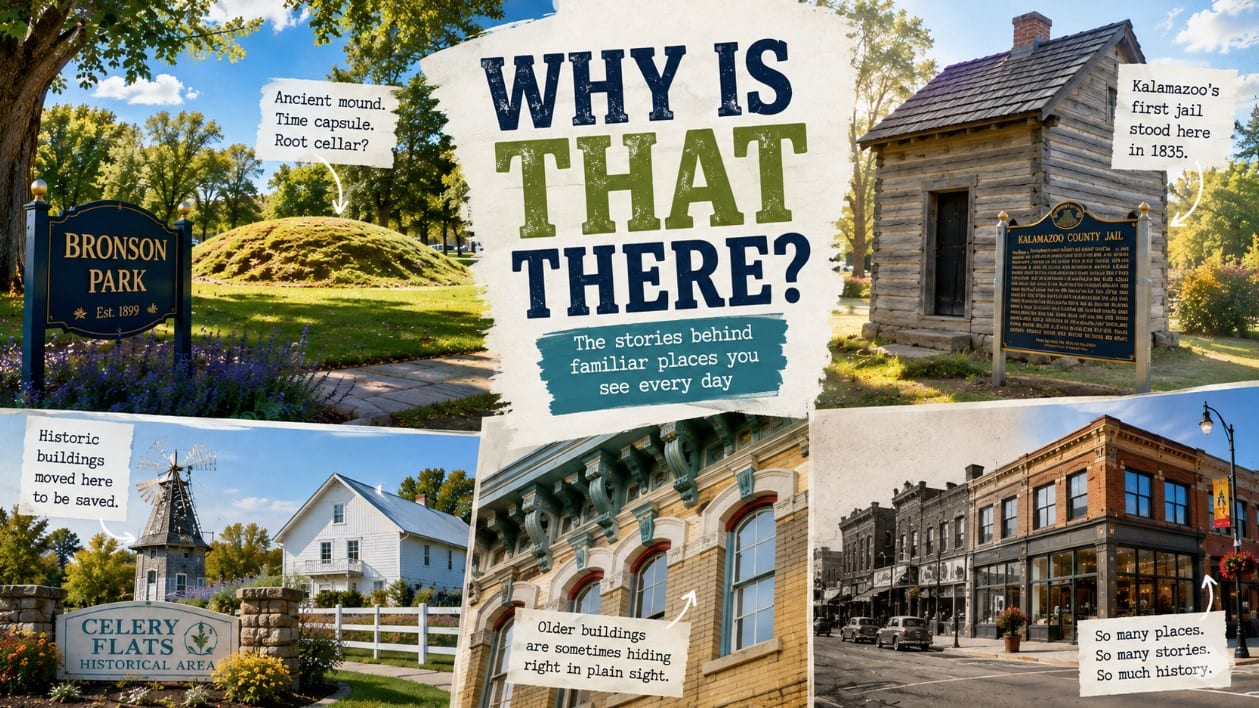
You've driven past it a hundred times.
You've probably looked at it and wondered what it was. But you were headed somewhere, the light turned green, and you kept going.
Kalamazoo and Portage are full of things like that—odd little pieces of our past sitting right in the middle of modern life.
So this week, KP Vibe decided to ask a simple question:
Why is THAT there? What's That Mound Doing in Bronson Park?
Let's start with perhaps the best one. That little grassy mound near the southwest corner of Bronson Park isn't landscaping.
It's believed to be a Native American mound dating from long before Kalamazoo existed. Early records indicate it was excavated in 1832, although that investigation apparently found nothing.
Then things get stranger.
During the 1840s, the hole left from that excavation was reportedly used by the nearby county jail as a root cellar.
In the 1850s, local businessman Alexander Sheldon restored the mound and buried a time capsule inside containing coins, newspapers and other items from the period.
A century later, in 1954, the capsule was recovered and another was placed inside.
And that one?
It's supposed to stay there until 2054.
So that innocent-looking hill you've walked past in Bronson Park is essentially an archaeological mystery, former root cellar and 100-year time capsule all rolled into one. Wait...There Was a JAIL in Bronson Park?
Yep.
The western half of today's Bronson Park was once called Jail Square.
Kalamazoo's first jail was built there in 1835—a 32-foot-long log structure with the sheriff's quarters on one end and cells constructed from enormous white-oak timbers on the other.
The eastern portion was known as Academy Square.
And here's another surprise: beginning in 1838, a branch of the University of Michigan operated there.
Eventually the street separating Jail Square and Academy Square disappeared, the properties were combined, and in 1899 the space officially received the name we know today:
Bronson Park.
Next time you're sitting there enjoying lunch, remember: you're relaxing where Kalamazoo once had both a jail and a university. Why Are All Those Old Buildings at Celery Flats?
This might be my favorite Portage example because the answer is:
Some of them weren't always there.
Celery Flats Historical Area was established in 1988 partly to preserve pieces of Portage history threatened or displaced by development.
Historic structures including a one-room schoolhouse, the Hayloft Theatre, Stuart Manor and the Grain Elevator were relocated to the area.
The Grain Elevator itself dates to 1931 and is recognized by the city as Portage's oldest surviving commercial building.
Stuart Manor goes back even further—to 1846—and is the oldest remaining structure in Portage. In other words, Celery Flats isn't simply an unusually well-preserved old neighborhood.
It's more like a collection of pieces of Portage history that were deliberately gathered together and saved. And Some Buildings Are Hiding Other Buildings
Here's one you'll probably start looking for after reading this. Kalamazoo historian Lynn Houghton has documented buildings around town where years of additions and renovations have partially swallowed the original structures.
Sometimes an old roofline remains. Somewhere else it might be a window, cornice or architectural detail that doesn't quite match the rest of the building.
One example sits at Rose and Lovell.
A small Greek Revival home once occupied the corner before Dr. Joseph Sill moved it and constructed a four-story apartment building called Sill Terrace in 1869. Over generations, the property was altered and adapted as Kalamazoo grew around it.
It's a reminder that sometimes local history isn't sitting behind glass in a museum.
It's hiding underneath the building you're looking at. What Else Are We Missing?
That's what makes this fun.
There are probably hundreds of signs, buildings, monuments, strange street names and little landmarks around Kalamazoo and Portage that most of us have passed for years without ever learning their stories.
And we'd like your help finding them.
What's something around Kalamazoo or Portage that you've driven past a hundred times and wondered:
"Why is THAT there?"
Tell KP Vibe about it. We'll see if we can find out. And who knows?
You may have just given us Part 2. |
6 Comments
Join the conversation
Had no idea the buildings at Celery Flats were moved there from other parts of town. I just assumed that whole area had always looked like that.
That was one of our favorite surprises too, Celery Flats feels so cohesive that it's easy to assume it grew naturally, but it's really more of a deliberate rescue mission for pieces of Portage history that might otherwise have been lost to development.
ray_portageSame here. I used to take my kids there and just thought it was a quirky little park. Finding out those buildings were rescued from demolition makes it feel a lot more meaningful honestly.
I drove past that mound in Bronson Park for years thinking it was just weird landscaping. A Native American mound turned root cellar turned time capsule is not what I expected to find out on a Tuesday.
Honestly, 'archaeological mystery turned root cellar turned time capsule' might be the most Kalamazoo sentence we've ever written, and the best part is there's still a capsule in there quietly waiting for 2054.
Trish HolmbergRight? I walked past it probably a hundred times going to the farmers market. Never once thought it was anything other than a landscaping bump. The root cellar part is what got me though, that's such a weird chapter in the middle of the whole story.